Part one
This is a long but quite simple story that has been overly complicated by the actions of Reform UK. It potentially demonstrates the total disregard Reform has for its own constitution, its rules and its commitment to the rule of law. We will be breaking the events down into a number of posts.
However, before we get into the nitty-gritty, we will draw your attention to a line within Reform’s own constitution that states the following:
“Further the Party shall at all times adhere to the principles of the rule of law ”.
This statement is a legal and ethical pledge. It means that the party in question [Reform UK] promises to conduct its affairs in accordance with the established legal system, rather than acting arbitrarily or placing itself above the law.
I ask you to remember this statement while you read the posts. The constitution is freely available to anyone and can be found here :Reform UK Constitution
Throughout this series of posts we ask that you become the jury. You would need to maintain an open mind regardless of your politicle position and draw your own conclusions. We would love to hear what you think of the process in the comments below.
The full history leading up to the interviews
Over a six-month period, branch officials and members of Sheffield Reform East actively promoted Reform UK within Sheffield communities. No one received payment for this work; they did it out of love for their city and a desire to see change. Alongside this activity, potential councillor candidates undertook councillor training created by members of Sheffield Reform East. They completed this training in their own time. The training aimed to prepare candidates for the responsibilities they would face if they became councillors and to prevent the issues that had affected Reform councillors in other cities. More than 50 councillors have left Reform UK for various reasons.
Branch officials wanted to reward the candidates for their hard work by announcing their official candidacy before the Christmas break. Everyone understood that once the New Year arrived, the candidates would need to increase their activity levels ahead of the May 2026 elections. The branch scheduled the announcement for 17th December 2025 and received approval from both the county coordinator (CO) and the regional director (RD).
It was suggested that each candidate should attend an interview process. However, despite repeated requests, the branch did not receive an official interview format. With 17th December fast approaching, the branch decided to design its own interview format.
The interviews
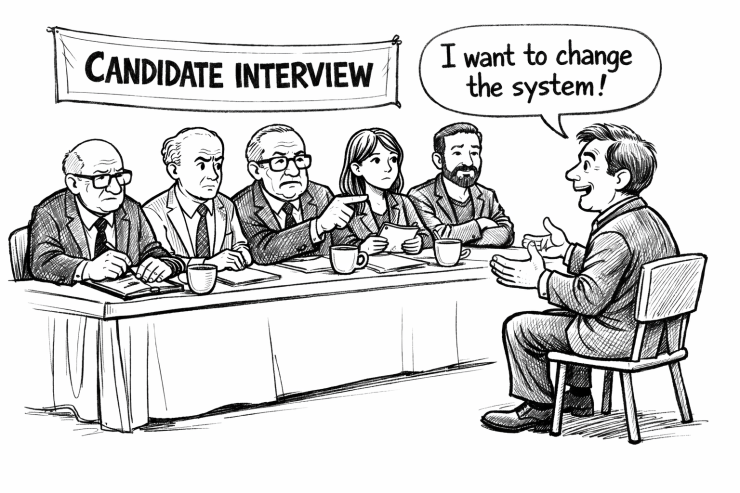
The branch held the first interviews on the 10th November 2025 at a local café. The organisers arranged the interviews outside the café’s normal opening hours. Attendance was restricted to invited individuals only. Each candidate received a specific time slot. The organisers structured these slots to give panel members, witnesses, and role players time between interviews to take comfort breaks or discuss the interviews.
The interview format remained straightforward. Each of the five panel members asked the candidate questions about relevant local issues. The branch provided example questions to guide the panel. After the questions, the candidate took part in three role-play scenarios, similar to those used in first aid courses and professional development programs. The scenarios reflected real issues faced by local communities that would assess how candidates would respond to and reassure constituents. Because the process involved three scenarios and four role players were available, it was suggested and agreed—rather than rotating roles—that two role players would act as a same-sex couple. No one in the room objected to this decision, including the acting chair, who held the authority to stop the interview at any time. A same-sex couple attending a councillor surgery to raise a community issue would not represent an unusual situation in a modern society.
A panel of five respected Reform UK members was selected to interview three candidates, with one panel member elected to chair the process. Only one panel member served as a branch official [interim]; he was not the chair. To ensure fairness, three additional Reform UK members were in attendance. This included the interim branch chair and interim campaign manager. The third additional member held no official position. Although the third member was the tutor who taught the candidates, he held no official position other than briefing the role players and candidates in the role play.
At the time, the interviews appeared successful. Everyone engaged positively with the process and even shared laughter. Nothing inappropriate occurred. No one present described the role plays as inappropriate or asked for them to be stopped.
So what happened next?

Six of the 12 people present received an email from Reform UK informing them of their suspension. That email is below in its entirety and unchanged but absent of any names.
UK, pending an investigation.
This decision has been taken under constitutional provisions 11.9 and 11.5.
During your suspension you must cease all Party-related activity and may not attend Reform
UK events including Branch meetings.
Any position you may hold on the Sheffield East interim Branch Committee is also suspended.
Reason
interview panel on 13 November, at the City Café, City Road, Sheffield.
own is against the Branch Rule 6.22.
If true, then asking these two people to undertake these actions caused them embarrassment, and was deeply inappropriate. As such it would have been damaging to the Party’s interests and brought the Party into disrepute.
Appeal
Under Constitutional provision 11.10, for matters such as these the Party Secretary shall
convene as soon as practicable an Emergency Disciplinary Panel.
To appeal the suspension carried out under 11.5 of the Constitution, please reply to me with
your response so that your views can be taken into consideration by the Emergency
Disciplinary Panel.
If you are in possession of a recording, please provide a copy of this with your reply.
I would ask that you do this no later than 26 November 2025.