Part three, The real story behind Reform Sheffield East expulsions

Throughout this series of posts, we ask that you become the jury and decide for yourself.  You would need to maintain an open mind regardless of your political position and draw your own conclusions. We would love to hear what you think of the process in the comments below.

Part one can be found here

Part two can be found here

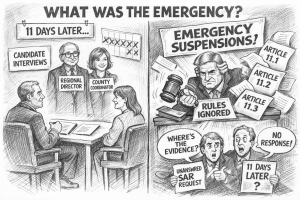
WHAT WAS THE EMERGENCY? What was the emergancy

The Party imposed the suspensions 11 days after the event. During that period, further candidate interviews went ahead with the full knowledge of both the regional director and the county coordinator.

Reform UK has clearly defined procedures for handling complaints.

Article 11.1 states, “All members are encouraged to resolve issues informally through their local branch.”

Article 11.2 continues: “If informal resolution has failed, a Member wishing to make a complaint must submit it in writing to their Regional Director.”

Article 11.3 then provides, Upon receipt, the Regional Director will acknowledge the complaint within thirty (30) working days and notify the Member against whom the complaint has been made.”

Only at Article 11.4 does the Constitution refer to escalation to the Disciplinary Committee. Branch rules also state that anonymous or unwritten complaints will not be acted upon. This would suggest there must be a written complaint; however, this was never presented.

We requested disclosure of the evidence relied upon to justify the suspensions, but the Party refused that request. A Subject Access Request (SAR) was submitted on 30th December 2025, triggering a statutory 30-day response period. That deadline has now passed, and no response has been received. This email was followed up, giving Reform a further seven days to respond. This matter has now been reported to the Information Commissioner’s Office.

The regional director knew the next round of interviews would be conducted on the 20th November, one day prior to the six receiving their suspension email. If the matter genuinely constituted an emergency and if the correct procedures had been followed, those interviews would have been halted immediately had the regional director received the initial complaint. The party seemingly bypassed this staged process entirely and invoked emergency powers without explaining why the established procedures proved inadequate or why urgency suddenly arose 11 days after the alleged incident and only one day after the second round of interviews.

THE FIVE QUESTIONS

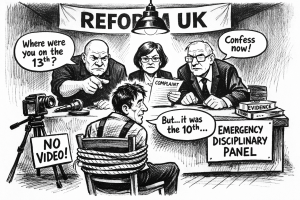
The suspension email required the six defendants to answer five questions in order to “appeal the suspension carried out under 11.5 of the Constitution, please reply to me with your response so that your views can be taken into consideration by the Emergency Disciplinary Panel.”

The instruction is clear and unambiguous: to appeal the suspension (this is important to remember), the defendants must respond to the five questions. What the email omits matters just as much as what it includes. It does not invite the accused to submit their own account of events or to provide a full statement in their defence.

Instead, it asks questions such as:

  • Did you try to prevent this taking place at the time?

  • Why did you not report this event to a Party official?

These two questions presume guilt; critics suggest that Reform UK reached their conclusions and asked these questions based solely on the complaint. Reform UK appears to have conducted no further investigation and sought no statements from the candidates or role-players. The party based the suspensions entirely on the original complaint, which it did not disclose to the six individuals concerned. One candidate received a phone call from Reform UK but could not take it at the time; when he later returned the call, Reform UK told him the matter had been resolved. This suggests that Reform UK recognised the need for further investigation but did not follow through with it.

Although the email did not request full statements, the six suspended individuals submitted them anyway, despite receiving no indication that the appeal process would consider such submissions. Each of the six, naturally, defended their actions in their own words.

Important note: At this stage, Reform UK had not conducted an investigation or received any statements from those involved except from the person who made the complaint.

The most serious accusation

The email made the following serious allegation:

“It is alleged you were part of this interview panel. While conducting the interview panel, a ‘role play’ segment was undertaken. It is alleged that during this role play, a male member was made to pretend he was gay and kiss another man, a candidate applicant, on the top of his head. The male member was also encouraged to sit on the candidate applicant’s knee in front of all who were present.”

However tempting it might be, please do not comment about the inappropriate wording used by Reform UK in the above quote.

Let’s break the accusations down.

“It is alleged you were part of this interview panel.”

Partly true, three of those suspended were on the interview panel, while three were not. Only one person from the interview panel was expelled.

“It is alleged that during this role play, a male member was made to pretend he was gay.”

At no point was anyone “made” to do anything. Again, the decision to portray a same-sex couple was taken jointly. We have written statements to prove this.

“[..]- kiss another man, a candidate applicant, on the top of his head.”

No, no one kissed anyone on the head or anywhere else. The author of a news article, who has seen the videos, can confirm this (Click here), as can witness statements that Reform UK did not seek. The party’s own verdict letter, sent by the Party Secretary-Barrister, corroborates this point when he reframes the accusation and states in the expulsion letter that the conduct involved “an air kiss to the top of the candidate’s head.” Once again, a lie that can be corroborated in the news article linked above.

“The male member was also encouraged to sit on the candidate applicant’s knee in front of all who were present.”

The role-players did not sit on anyone’s knee, nor did anyone encourage them to do so. Again, both the journalist who viewed the footage and the witness statements corroborate this. In the verdict letter, the Party Secretary-Barrister again reframed the original allegation, describing the conduct as to move into the personal space of a candidate, to perform an air kiss to the top of the candidate’s head, and to engage in further physical proximity in front of those present.”

The original suspension email made no reference to a role-player “moving into the personal space”. Had it done so, we would have acknowledged that fact. One role-player did enter a candidate’s personal space, but only after the role-play had ended. The role-players and candidates were mutual acquaintances. No other interaction occurred. The journalist who reviewed the videos can also corroborate this. (I will say again, if permission is granted, we will share the videos).

The suspension email continues: “If true, then asking these two people to undertake these actions caused them embarrassment and was deeply inappropriate. As such, it would have been damaging to the Party’s interests and brought the Party into disrepute.”
“If true,”
A simple investigation would have proven this allegation not to be true.
[…]-then asking these two people to undertake these actions caused them embarrassment.”


The manner in which this is worded is compelling in itself. “Caused them embarrassment” – who? Both role-players have given statements saying they were not embarrassed; quite the opposite, they say they enjoyed the interview process. The panel members and witness voiced no concerns during the interviews despite having the authority to halt proceedings. All three candidates said the interviews were taxing but enjoyable. The only possible conclusion one could draw is vicarious embarrassment—a psychological phenomenon in which someone feels embarrassment on behalf of another. This does not mean the actions themselves were embarrassing or inappropriate; it merely reflects an individual’s subjective reaction to an occurrence.

We reiterate,  if Reform UK had conducted an investigation and spoke with the role players and candidates, the matter could have been resolved quickly, without fuss and without the dia mess Sheffield Reform East now finds themselves in.

“and was deeply inappropriate”.

These four words say more about those at Reform UK than they do about those people suspended. What was “deeply inappropriate” about a same-sex couple seeking advice from their local councillor?

“As such, it would have been damaging to the Party’s interests and brought the Party into disrepute.”

Apart from the fact that it didn’t happen, how would an interview process depicting a same-sex couple damage the party’s interests and ‘brought’ the party into disrepute?

Eleven days had passed since the original email was delivered; a second round of interviews had already been conducted with some of the same people on the panel. One person who was suspended and sat on the panel in the original interview acted as a role player in the second round of interviews. He was the person who faced no further consequences.


The Verdict

Six people were suspended; of those, four were expelled from the party for life. One faced a six-month suspension, while the sixth faced no action at all. No explanation was given as to why the verdicts were different. Our opinion is that at some point these two people changed their story to suit the narrative to avoid further sanctions.

Obviously, the four who were expelled wanted to appeal this decision, but that was refused. That’s another story involving a barrister and a strawman defence. We will look at this in part four.
 

MP's under fire

MP’s earnings

I have a dangerously radical idea, one that would instantly separate MPs who are actually in politics out of love for community and country from those who’ve mistaken Westminster for an all-inclusive luxury cruise.

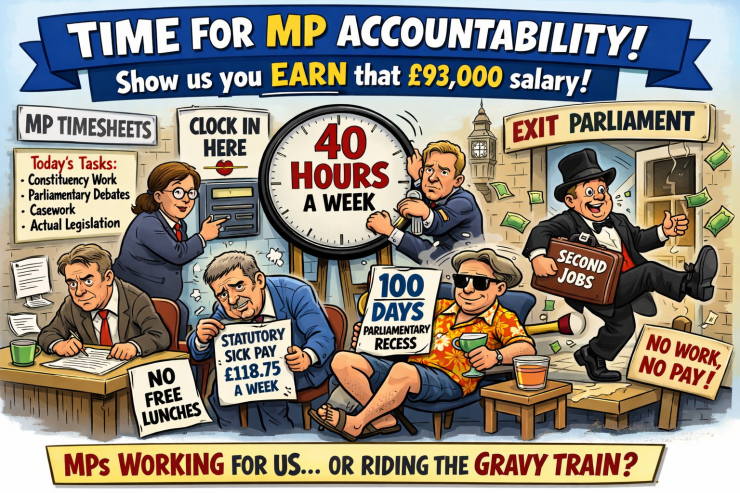
What if MPs had to clock in, fill out timesheets, and justify their £93k salary?

An MP earns roughly £93,000 a year. Based on a standard 40-hour week, that’s about £45 an hour. For that sort of money, I’d expect a little more graft and a little less “I’ll just dial this one in from the sofa.” And yes, Nigel, that includes not working by proxy either. Revolutionary stuff, I know.

Here’s the concept: if MPs aren’t physically working in their constituency, they should be in Parliament. Wild. I know, right? And to make this madness measurable, all MPs should complete timesheets showing exactly how they spend their working day.

Before anyone faints:
– Breaks don’t count.
– Lunch doesn’t count.
– Party-promotion events don’t count.

Only the hours spent actually working for us—you know, the people paying the bill- should count.

Travel time? Nope, absolutely not. They already claim thousands in travel expenses and enjoy subsidised food. Do you get paid for commuting? Are you reimbursed for your food habit? No? Thought not.

Parliament is in recess for around 100 days a year, which is already generous by normal human standards, but fear not—MPs can still work a 40-hour week in their constituency during that time. The horror of it all; I can see them clutching their pearls already.

Naturally, they should receive 28 days’ holiday per year, which must be booked in advance like the rest of civilisation. If they’re ill, they get Statutory Sick Pay—£118.75 a week for up to 28 weeks. Again, just like everyone else who is bravely holding the country together without a chauffeur.

Yes, I realise this might severely interfere with their second, third, or fourth jobs—but tragic as that is, being an MP is supposed to be a full-time job, a calling. Not a side hustle. Not a networking opportunity. Not a stepping stone to the after-dinner speaking circuit.

Finally, they publish the timesheets. Come election time, voters can see which MPs offer the best value for money—just like any other product we buy. And let’s be clear: if we’re paying for it, then we are buying it.

Funny how accountability suddenly feels like an extreme sport when it applies to the people at the top.

Fake pensioner

You couldn’t make this up

Welcome back to This Week in You Absolutely Couldn’t Make This Sh!t Up. Today’s episode features the Gorton and Denton by-election, Matt Godwin of Reform UK, one mysteriously prolific pensioner, and a printing company.

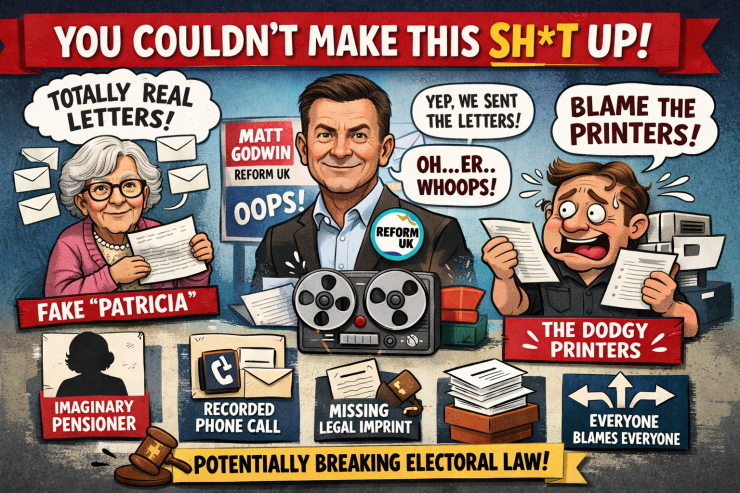
So, constituents received a heartfelt letter from a woman named Patricia. Patricia, we are told, is a disgruntled pensioner bravely speaking truth to power. Touching stuff. One tiny hitch: Patricia does not exist. Not in the “can’t be reached right now” sense, but in the “entirely fictional character” sense.

Even better, the envelope helpfully lists the printer’s address as the return address. Subtle. Sleek. Truly the Banksy of political operations.

Turn Left Media, sensing blood in the water, rang the number on the envelope and asked—politely, one assumes—for Patricia. Cue recorded call, cue awkward pause, cue printer cheerfully admitting that yes, they did indeed send the letters out. For a brief moment, honesty lived. The video can be found here.

They then went on to explain that this was official Reform party literature sent to people on the electoral register. Oops. Silly little slip. Happens to the best of us. You know—when your imaginary pensioner accidentally becomes an authorised political campaign.

But wait, there’s more…

There’s also the small, fiddly issue of the imprint. That boring bit of text that says “Printed by X on behalf of Y” and exists because democracy occasionally enjoys a paper trail. It is, inconveniently in this case, a legal requirement that it is, inconveniently, missing.

This means Reform may have—purely hypothetically, of course—broken electoral law. Naturally, Reform’s response was swift and decisive: blame the printers. I look forward to their response.

Yes, the same professional printers who, by their own admission, were responsible for most of Reform’s printing somehow didn’t notice a missing legal requirement on a full print run of party political material. Easy mistake. Happens all the time. Like forgetting to put wheels on a car.

And finally, let’s all cross our fingers and hope Reform remembered to declare the expense, because if they didn’t… well, things could get really messy.

So to recap:
• Fake pensioner
• Real letters
• Printer spills the beans on tape
• Legal imprint missing
• Expenses question mark
• Everyone points at everyone else

Democracy, folks. Working beautifully. 🍿

Labour on the brink of extinction

Starmer, Mandleson and Epstien walk into a bar…

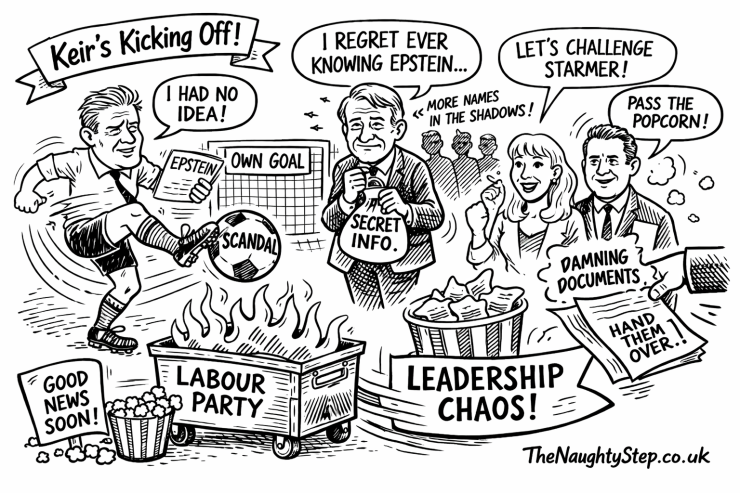
Keir Starmer has well and truly booted the ball into his own net, hasn’t he? Not just a toe-poke either — a slow-motion disaster.

Starmer admitted he knew about Peter Mandelson’s past association with Jeffrey Epstein and still waved him through to become British Ambassador to the good ol’ U-S of A. Then Starmer tells us Mandelson didn’t fully disclose his dealings—that some market-sensitive information may have been passed. Oh-come-on. Of course he didn’t. Since when do people hand their boss a neat bullet-point list titled “All the Things That’ll Ruin Us”? No shit, Sherlock.

My personal favourite is Mandelson’s pearl-clutching regret about “ever having known Epstein” and for maintaining contact after his conviction. A sentiment I imagine is currently being whispered—or screamed into pillows—by more than a few very prominent figures. And let’s be honest, there are probably some names still hiding in the shadows, with their phones and news outlets switched off.

Then comes Starmer’s apology tour, where he bravely tells the so-called ‘rebels’ he will not step down. Strong stuff. Inspirational, even. Which is presumably why Labour MPs have privately nudged Angela Rayner and Wes Streeting to consider launching a leadership challenge. History lesson: remember when Theresa May, Boris Johnson, and Liz Truss all said that exact same thing? Yeah, masterclasses in how that ends.

Now the government has to hand over papers that may prove… Let’s say unhelpful to Starmer’s continued employment prospects. Never ideal when documents become the main character.

Meanwhile, the Labour Party is clearly desperate for a win—any win—to distract us from the flaming skip fire currently roaring away. Expect some conveniently timed “good news” to drop very soon. Possibly involving funding, reform, or a hastily dusted-off slogan.

Popcorn at the ready.
The next few days could be very entertaining.

Farage broken Britain

Never trust a Tory

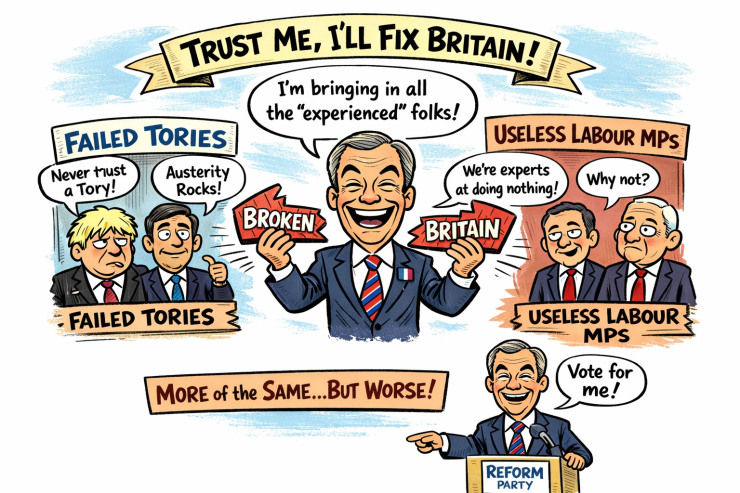
Nigel Farage has said many times that Britain is broken, and on that rare occasion, I find myself nodding along. He’s also been very clear that Brexit hasn’t delivered the sunlit uplands promised, and he’s laid the blame squarely at the feet of the Conservatives. Fair enough. After all, there’s no shortage of clips of Farage solemnly warning the nation that you should never trust a Tory.

Which makes it all the more impressive that he’s now welcoming those very same failed Tories into his party. Apparently, “never trust a Tory” now comes with an asterisk.

These are, of course, the same Conservatives who treated the country to 14 years of austerity. Despite periods of high employment, they somehow managed to leave us with the highest tax burden in 70 years and wages that have barely moved since the iPhone was invented.

The same Tories who hollowed out health and social care, tripling NHS waiting lists in England to 7.6 million, widening health inequalities, and ensuring that if you were poor, you were also more likely to die earlier. Efficient, if nothing else.

The same Tories who gave us five Prime Ministers — Cameron, May, Johnson, Truss, and Sunak — each one a thrilling new episode in the long-running political soap opera How Low Can We Go? Complete with constant policy U-turns, because consistency is for amateurs.

The same Tories who stood by while 2.8 million people — about 4% of the population — lived in households reliant on food banks. But don’t worry, they assured us the economy was doing great.

The same Tories who quietly removed 20,000 police officers, presumably to encourage criminals to develop a sense of personal responsibility.

And, in a final flourish, the same Tory government that opened the gates for a massive Labour majority, paving the way for the mess we’re now told is someone else’s fault entirely.

Now Farage says he’ll also be welcoming former and current Labour MPs into the fold. MPs who, since handing power to the Conservatives in 2010, have achieved precisely nothing. A bold recruitment strategy: assemble a greatest-hits album of political failure and call it “experience.”

Reform may well seize power at the next general election, whether outright or via a hung parliament. If that happens, the cabinet will inevitably be stacked with the very “experienced” ex-Tories Farage assures us we need. In other words: more of the same, but with a new logo.

And yet, people will still vote for him.

Yes, Britain is broken. But if this is the repair plan, don’t expect it to be fixed anytime soon.

Find us on Facebook

Part two, The real story behind Reform Sheffield East expulsions

Throughout this series of posts, we ask that you become the jury and decide for yourself. You would need to maintain an open mind regardless of your political position and draw your own conclusions. We would love to hear what you think in the comments below.

Part one can be found here

Those suspended, along with the candidates and the role players, maintain that nothing untoward occurred during the interviews. The video proves this (more on this later) The only person or persons who felt embarrassed appear to be those who made the initial complaint. It is worth remembering that a dozen people were present in the café, excluding the candidate, yet the party suspended only six. We do have statements from the role players and the candidates who took part in the interviews.

A BASIC SCHOOLBOY ERROR You're guilty until proven innocent.

The email referenced in Part One stated, “We have received a complaint of inappropriate conduct during a Sheffield East candidate interview panel on 13th November, at the Café, Sheffield.”

The interviews took place on the 10th November, not the 13th November, as the email claimed. Reform UK has failed to address this fundamental schoolboy error in any of its correspondence. One must ask what would have happened had those suspended denied being present on the 13th. Regardless, and in the spirit of full cooperation, all six chose to respond.

Although the following error may seem minor at first glance, it remains important for the record. The same email then made the following assumption: “It is alleged you were part of this interview panel.”

Because the party sent this identical email to all six individuals, the statement was demonstrably false. While three of those suspended served on the interview panel, the other three did not. The panel itself consisted of five members, yet the party suspended only three. All three witnesses received suspensions, even though one of them did not hold an official branch role.

THE ALLEGED VIDEO RECORDING

The email went on to state:
“It is also alleged that during this interview/event a video recording was made, which on its own is against Branch Rule 6.22.” 

The branch rules appear to have been updated on 6th November 2025, just four days before the first interview took place. the new rules were not forwarded to all the panel members or witnesses. Rule 6.22 is a new addition.  The old rules are freely available here; however, the new rules are not online at the time of writing this blog.

Branch Rule 6.22 states the following: “Video or audio recording of branch meetings is strictly prohibited. Failure to comply with this provision may result in disciplinary action.”  Clearly it prohibits the video recording of branch meetings; however, the glossary within the rules defines branch meetings as “meetings of all eligible branch members and branch officers.”  The interviews were not open to all members, and not all branch officials received invitations. As a result, the interviews did not meet Reform UK’s own definition of a branch meeting, and video recording was therefore permitted.

The verdict letter (soon to be released) states, “The committee is further satisfied that the session was recorded.” This wording suggests that Reform UK has ignored its own rules, which only prohibit the recording of branch meetings. This was not a branch meeting according to Reform UK’s own rules and definitions.

Although the interviews were not a training exercise, organisations often video-record interviews for future training purposes. All three candidates were asked whether they wanted their interviews recorded for training purposes, and all three agreed.  The videos were not given to Reform UK because we needed permission from everyone featured in them to comply with general data-protection guidelines. Moreover, if the scenarios had caused embarrassment, anyone sharing the video would have compounded that embarrassment. Reform UK claimed that we did not need permission because the matter was internal. At this point our trust in Reform UK was at its lowest; as such, their interpretation could not be relied upon.

Furthermore, if the video recording had breached party rules, responsibility would have fallen on all 12 people present, not just six. This selective enforcement further undermines the credibility of the allegation.

We will reiterate: we did not share the video with Reform UK because we wanted to safeguard the role-players and candidates and Reform’s interpretation of GDPR. Also, we did not trust Reform UK to keep the video private. Protecting our members’ rights was more important to us than our suspension. If permission is granted, we will post the videos here in due course.

The video exonerates all six accused individuals. An independent witness—a Yorkshire Live journalist who viewed the footage—confirms this. In the article, he writes: “A video of the interview—seen by YorkshireLive […]—shows that at no stage does he kiss the candidate’s head or sit on his lap.” The full article is available at Yorkshire Live. Yorkshire Live news article

PARTY SECRETARY OR CHAIRMAN?

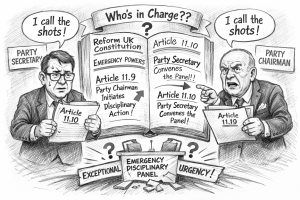
Image showing party chair and secretary arguing over who is control

The following issue is complicated by the specific roles individuals hold within the party. It is worth noting at this stage, for future reference, that the Party Secretary must be a barrister.

A further issue arises from the following statement in the email: “Under constitutional provision 11.10, for matters such as these, the Party Secretary shall convene as soon as practicable an Emergency Disciplinary Panel.”

Articles 11.9–11.12 fall under the heading “Emergency Powers” and set out a clear sequence for their exercise, indicating that the constitution intends them to operate in a specific order. Article 11.9 provides that, in cases of exceptional gravity and urgency, the Party Chairman must initiate the process by exercising the relevant powers and notifying the Party Secretary.

The suspension email makes no reference to Article 11.9. Instead, it invokes Article 11.10 directly. The email was sent and signed by the General Secretary, not the Party Chairman, and did not include the original complaint. This suggests that the accusation may reflect the General Secretary’s own interpretation rather than a formally initiated process.

By invoking an emergency disciplinary procedure, the party necessarily treats the matter as one of exceptional gravity and urgency. In such cases, the constitution is explicit: the Party Chairman must initiate the process and notify the Party Secretary. That step is seemingly absent here. Instead, the action appears to have been taken solely by the General Secretary, contrary to the constitutional requirements.

One further omission

The suspension email also omitted both the opening words and the concluding language of Article 11.10, despite their importance to understanding the prescribed process. Article 11.10 states in full: “Upon being so notified, the Party Secretary shall convene as soon as practicable an Emergency Disciplinary Panel composed of himself (or an independent chairman appointed in accordance with the Rules made under Article XI.7 and XI.8) and not more than two voting members of the Board.”

The provision begins with the phrase “upon being so notified”, which confirms that someone, in this case the Party Chairman, must notify the Party Secretary before any action can be taken. None of the correspondence clarifies whether such notification occurred. Nor does it state whether the Party Chairman authorised the suspensions.

Any action taken without that authorisation would constitute a breach of the constitution and would bring the party into disrepute. The Party Chairman was invited to comment, but no response has been received to date.

Summary

  • The suspension email misstated the interview date as 13th November instead of 10th November. Reform UK never corrected this error.

  • The email falsely asserted that all six suspended individuals sat on the interview panel. Only three did.

  • The panel had five members, yet the party suspended only three panellists and three witnesses, including one person with no official role.

  • The party alleged that video recording breached Branch Rule 6.22, which applies only to branch meetings. The interviews were not branch meetings under the party’s own definition, making the allegation unfounded.

  • Reform UK enforced the rule selectively. Twelve people attended the interviews, but the party suspended only six.

  • The video fully clears all six individuals, a fact confirmed by an independent Yorkshire Live journalist who viewed the footage (in fairness this was not shared with Reform UK for the reasons mentioned above)

  • Reform UK allegedly invoked emergency disciplinary powers without following its constitution. Article 11.9 requires the Party Chairman to initiate the process in urgent cases. The party bypassed this step and cited Article 11.10 out of sequence.

  • The suspension email came from the General Secretary, not the Party Chairman, and omitted the original complaint.

  • The party omitted critical wording from Article 11.10, including the requirement that the Party Secretary, not the General Secretary act only “upon being so notified” by the Party Chairman.

  • Reform UK has not confirmed whether the Party Chairman authorised the suspensions. Requests for clarification remain unanswered.

There is a lot to digest in this episode, so we will leave it there for now. Part three can be found here. 

Feel free to leave a comment or two.


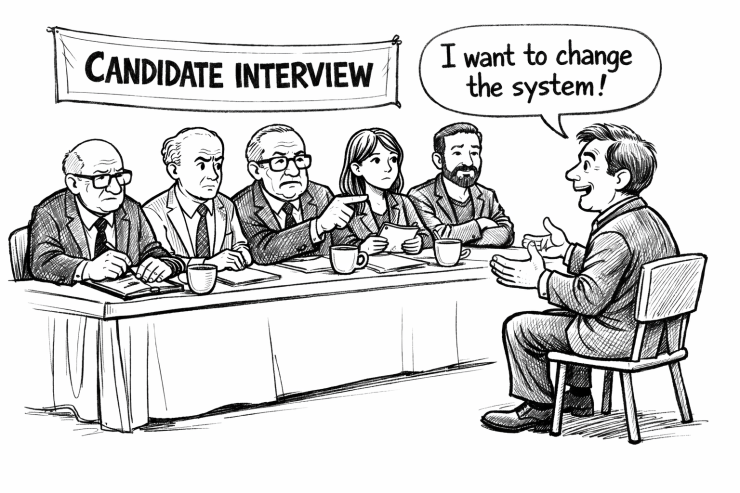
Candidate interview

Part one, The real story behind Reform Sheffield East expulsions

Part one

This is a long but quite simple story that has been overly complicated by the actions of Reform UK. It potentially demonstrates the total disregard Reform has for its own constitution, its rules and its commitment to the rule of law. We will be breaking the events down into a number of posts.

However, before we get into the nitty-gritty, we will draw your attention to a line within Reform’s own constitution that states the following:

“Further the Party shall at all times adhere to the principles of the rule of law ”.

This statement is a legal and ethical pledge. It means that the party in question [Reform UK] promises to conduct its affairs in accordance with the established legal system, rather than acting arbitrarily or placing itself above the law.

I ask you to remember this statement while you read the posts. The constitution is freely available to anyone and can be found here :Reform UK Constitution

Throughout this series of posts we ask that you become the jury. You would need to maintain an open mind regardless of your politicle position and draw your own conclusions. We would love to hear what you think of the process in the comments below.

The full history leading up to the interviews

Over a six-month period, branch officials and members of Sheffield Reform East actively promoted Reform UK within Sheffield communities. No one received payment for this work; they did it out of love for their city and a desire to see change. Alongside this activity, potential councillor candidates undertook councillor training created by members of Sheffield Reform East. They completed this training in their own time. The training aimed to prepare candidates for the responsibilities they would face if they became councillors and to prevent the issues that had affected Reform councillors in other cities. More than 50 councillors have left Reform UK for various reasons.

Branch officials wanted to reward the candidates for their hard work by announcing their official candidacy before the Christmas break. Everyone understood that once the New Year arrived, the candidates would need to increase their activity levels ahead of the May 2026 elections. The branch scheduled the announcement for 17th December 2025 and received approval from both the county coordinator (CO) and the regional director (RD).

It was suggested that each candidate should attend an interview process. However, despite repeated requests, the branch did not receive an official interview format. With 17th December fast approaching, the branch decided to design its own interview format.

The interviewsCandidate interview

The branch held the first interviews on the 10th November 2025 at a local café. The organisers arranged the interviews outside the café’s normal opening hours. Attendance was restricted to invited individuals only. Each candidate received a specific time slot. The organisers structured these slots to give panel members, witnesses, and role players time between interviews to take comfort breaks or discuss the interviews.

The interview format remained straightforward. Each of the five panel members asked the candidate questions about relevant local issues. The branch provided example questions to guide the panel. After the questions, the candidate took part in three role-play scenarios, similar to those used in first aid courses and professional development programs. The scenarios reflected real issues faced by local communities that would assess how candidates would respond to and reassure constituents. Because the process involved three scenarios and four role players were available, it was suggested and agreed—rather than rotating roles—that two role players would act as a same-sex couple. No one in the room objected to this decision, including the acting chair, who held the authority to stop the interview at any time. A same-sex couple attending a councillor surgery to raise a community issue would not represent an unusual situation in a modern society.

A panel of five respected Reform UK members was selected to interview three candidates, with one panel member elected to chair the process. Only one panel member served as a branch official [interim]; he was not the chair. To ensure fairness, three additional Reform UK members were in attendance. This included the interim branch chair and interim campaign manager. The third additional member held no official position. Although the third member was the tutor who taught the candidates, he held no official position other than briefing the role players and candidates in the role play.

At the time, the interviews appeared successful. Everyone engaged positively with the process and even shared laughter. Nothing inappropriate occurred. No one present described the role plays as inappropriate or asked for them to be stopped.

So what happened next?

naughty step timeout moment

Six of the 12 people present received an email from Reform UK informing them of their suspension. That email is below in its entirety and unchanged but absent of any names.

———————————————————
Dear #########

Peter Tatchell arrested

Green party activist and human rights campaigner arrested

Peter Tatchell is an Australian-born British human rights campaigner. A member of the Green Party, he was arrested for carrying a placard calling for a global intifada. To be fair, the sign also said “non-violent resistance”; however, that is not what “intifada” means. Just to be clear, “Intifada” refers to a rebellion or resistance movement, commonly used to describe Palestinian uprisings against Israeli occupation.
A peace-loving Green Party member is calling for a violent uprising against Jews (presumably). What would happen if the small minority of Muslims who live in the UK who agree with him started said intifada?
The Greens have the nerve to call anyone to the right of their belief a fascist and/or a Nazi. Nazism incorporates antisemitism – the murder of the Jewish people. One of the descriptors of fascism is the forcible suppression of opposition. It is not those on the right of the political spectrum who are calling for the extermination of a race or calling for the suppression of Israel by force.
And they call the right wing violent…
What are your thoughts? Comment below and please share.